At a Glance
Chartering a vessel means contracting dedicated ocean capacity for a specific voyage, time period, or full operational use of the ship — distinct from booking space on a scheduled liner service. The decision is forced by three conditions: cargo that physically cannot move on liner services (oversized, overweight, or specialized handling), project timelines that liner schedules cannot meet, or a per-ton cost crossover at large parcel volumes. Most heavy lift, project cargo, mining capital equipment, and offshore energy installations move under a voyage charter, time charter, or part charter rather than liner booking. The 2026 market is unusually tight on heavy lift capacity, which has pulled the planning horizon for these moves back to 90 to 180 days before first lift.
What "Chartering a Vessel" Actually Means
A vessel charter is a contract between a shipowner and a charterer that allocates dedicated vessel capacity — either the whole ship or a clearly defined portion of it — for a specific purpose. The contract is called a charter party (from the Latin charta partita, meaning "divided document"). The charterer is not buying freight space the way an importer books a container on a scheduled liner. The charterer is contracting the vessel itself, on negotiated terms, for a defined voyage or period.
Most international charter party contracts are based on BIMCO standard forms. BIMCO (the Baltic and International Maritime Council) is the world's largest direct-membership shipping organization, with members representing approximately 60% of the global merchant fleet by tonnage. BIMCO publishes the standard contracts the industry treats as the default starting point — GENCON 1994 for general voyage charters, HEAVYCON 2007 and HEAVYLIFTVOY for heavy lift, NYPE 2015 for time charters, BARECON for bareboat charters, SUPPLYTIME for offshore supply, and WINDTIME for offshore wind. The forms are not the entire contract; charterer and owner negotiate riders and amendments on top of the base form. But the form is the framework.
Understanding which charter form applies to a given move is the first decision in the process — because it dictates how risk, liability, and operational control are allocated between the parties for everything that follows.
The Three Primary Charter Types (and the Heavy Lift Specifics)
Charter contracts fall into three structural types based on what the charterer is actually buying:
| Charter type | What the charterer hires | Who operates the vessel | Common BIMCO form |
|---|---|---|---|
| Voyage charter | A specific voyage from load port to discharge port | The owner — crews, fuels, and operates | GENCON 1994 (general) HEAVYCON 2007 (semi-sub heavy lift) HEAVYLIFTVOY (mid-size heavy lift) |
| Time charter | Full use of the vessel for a fixed period | The owner crews and maintains; charterer directs operations | NYPE 2015 LINERTIME |
| Bareboat charter | Full operational control of the vessel | The charterer — supplies crew, fuel, insurance; acts as owner | BARECON |
Two important distinctions specific to heavy lift cargo:
HEAVYCON 2007 vs HEAVYLIFTVOY. HEAVYCON is the BIMCO standard for super heavy lift moves on semi-submersible vessels — typically a single, very large cargo piece carried on deck under a knock-for-knock liability regime. HEAVYLIFTVOY is the newer mid-sized heavy lift form, used for lift-on/lift-off operations on multipurpose vessels carrying parcel cargoes on and under deck, under conventional Hague/Hague-Visby cargo liability. The cargo profile decides which form fits.
Full charter vs part charter. Not every project cargo move requires booking an entire vessel. A part charter or parcel charter reserves a defined portion of vessel capacity — often used when a single shipper has cargo too large for liner service but not large enough to fill a vessel alone. Multiple shippers' cargoes can share a vessel under separate charter contracts, with each shipper holding rights to its allocated space.
When Cargo Characteristics Force a Charter Decision
Some cargo cannot physically move on a scheduled liner service. When that is true, chartering is not a strategic option — it is the only option. The cargo characteristics that force a charter include:
- Dimensions exceeding standard equipment. A 40-foot container has an internal length of about 39.5 feet and an internal height of about 7.8 feet. Open-top and flat-rack containers extend the envelope but still cap out at roughly 53 feet of usable deck length. Cargo that exceeds those dimensions — long shafts, large vessels, modular plant sections, transformer housings, mining mills — has nowhere to fit on a standard liner box vessel.
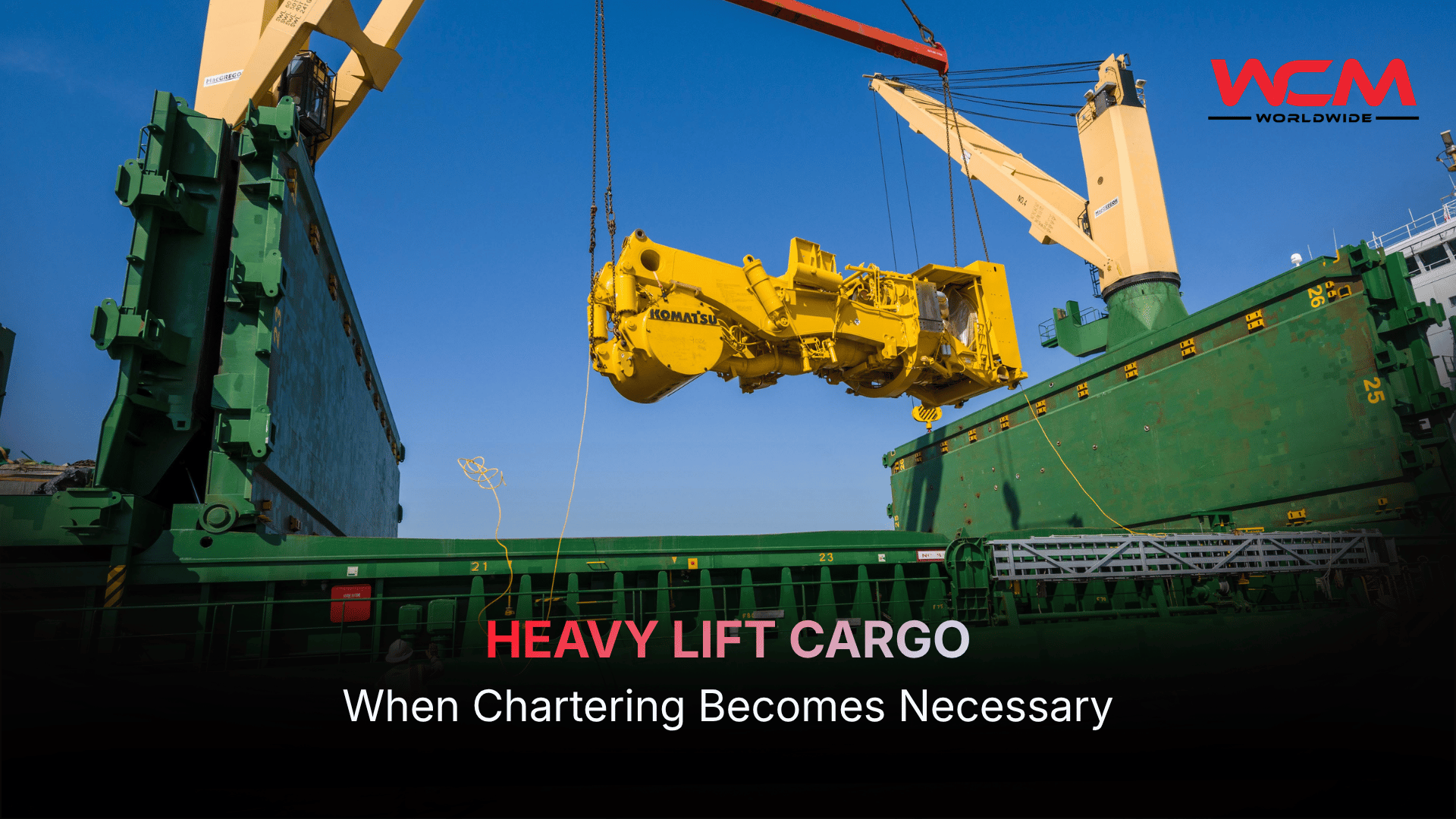
- Lift weight exceeding crane capacity. Liner vessels and most ports handle pieces in the 20 to 45 metric ton range routinely. Single pieces above that — power transformers, hydraulic excavators, ball mill shells, refinery vessels, offshore monopiles — require either heavy-lift cranes onboard the vessel itself or specialized shore cranes at both ends. The vessel and the port both have to be matched to the lift.
- Specialized cargo profiles. Float-on/float-off (FLO-FLO) cargoes — semi-submersible drilling units, large floating sections, deck modules — load onto semi-submersible vessels that ballast down, float the cargo on, and reballast for the voyage. There is no liner equivalent. Roll-on/roll-off (RO-RO) cargo for large self-propelled equipment, mining trucks, and rolling stock similarly requires specialized RO-RO or multipurpose vessels.
- Cargo characteristics excluded from liner service. Hazardous classifications, oversize moisture-sensitive cargo, project cargo that requires continuous stowage supervision, and high-value items requiring single-bottom voyages all fall outside what liner services accept or perform well.
The practical question on these moves is not whether to charter. It is which charter type, which vessel class, and which port pairing fits the cargo.
When Project Timing Forces a Charter Decision
The second condition that forces a charter is timing. Even when cargo could physically fit on liner service, the project may not survive liner timing. Three situations drive timing-based charter decisions:
Construction critical path misalignment. Large industrial, mining, and energy projects are built around an integrated construction schedule. If a transformer is needed on site in week 36, that delivery date is hard-wired to every other commitment that follows it — civil works, electrical commissioning, performance testing, commercial operation date. A liner schedule that would deliver in week 39 is not a three-week freight delay. It is a three-week construction delay that often costs more than the cargo itself.
Seasonal and geographic windows. Many trade lanes have hard timing constraints — monsoon windows for South Asia and West Africa, ice-class periods for Arctic and Baltic ports, low-water seasons on inland routes, hurricane exclusions for Gulf operations. When a project's only viable delivery window is narrower than liner frequency, chartering buys the precise voyage date the project needs.
Capacity-constrained markets. The 2026 heavy lift market is the cleanest example. Offshore wind installation alone is projected to drive the global offshore wind construction vessel market to roughly $28 billion in 2026, with charter rates rising as suitable heavy-lift and installation vessel capacity remains structurally tight. Demand from offshore wind, oil and gas decommissioning, and mining capital equipment is converging on the same fleet — and projects that wait for liner alternatives lose the vessels first. In this environment, securing charter capacity early is itself a project risk control.
When Cost Forces a Charter (and When Liner Is Still Cheaper)
Cost is the third forcing condition, but it works differently than the first two. Cargo characteristics and timing either rule out liner or do not. Cost is a continuous calculation that crosses over at large parcel sizes.
Liner rates are priced per container or per cubic meter and built around vessel sharing across many shippers. They are efficient at small parcels. Charter rates are priced per voyage (or per day, for time charter) and built around dedicated capacity. At small parcels, charter cost per ton is high. At large parcels — full ship loads of bulk equipment, multi-piece project moves, or multiple components requiring coordinated arrival — the per-ton cost of chartering can cross below the equivalent liner cost.
Three cost dimensions need to be priced together:
- Direct freight cost — the charter party rate or the equivalent liner spot rate, calculated per ton of cargo or per cubic meter loaded.
- Risk-adjusted cost — the expected cost of liner detention, demurrage, equipment loss, schedule failure, and project delay. On critical-path cargo this is often a multiple of the freight rate itself.
- Total landed cost — port handling at both ends, stowage and lashing, surveying, customs, inland delivery, and insurance. Charter and liner allocate these costs differently and the headline rate alone does not capture the comparison.
The cost decision is not whether charter freight per ton is lower than liner freight per ton. The decision is whether the total project cost — including the cost of being wrong on timing — is lower under one structure or the other.
How to Plan a Charter: The 90 to 180 Day Process
Charter planning for heavy lift and project cargo is engineering work as much as freight work. The horizon is rarely shorter than 90 days; on capacity-constrained corridors it stretches to 180 days. The process moves through six stages:
1. Cargo Engineering
Dimensions, gross weight, center of gravity, lashing point locations and load capacities, cradle and saddle requirements, environmental sensitivities. Every downstream decision depends on the engineering data, and incomplete data at this stage compounds into route, vessel, and port problems later.
2. Vessel Selection
Match the cargo profile to a vessel class — multipurpose vessel (MPV), heavy lift vessel (HLV), semi-submersible heavy transport, deck carrier, or specialized installation vessel. Vessel selection criteria include crane capacity and dual-lift capability, hatch dimensions, deck strength, tween deck configuration, draft restrictions at intended ports, and crew certification for the specific cargo type.
3. Charter Party Negotiation
Select the appropriate BIMCO form (GENCON, HEAVYCON, HEAVYLIFTVOY, NYPE, BARECON, SUPPLYTIME, or WINDTIME), then negotiate riders covering laytime, demurrage, off-hire conditions, cancellation rights, deviation, sub-charter rights, war and piracy risk, and any cargo-specific exclusions. Charter party drafting is a specialized legal discipline; engaging brokers and counsel experienced in the relevant form materially reduces dispute exposure.
4. Port and Terminal Coordination
Confirm vessel acceptance at load and discharge ports — air draft restrictions, berth length, crane availability if shore lifts are required, terminal handling tariffs, escort and pilot arrangements, road and rail access for inland movement. Out-of-gauge cargo often requires route surveys (bridge clearance, road camber, turning radius) before the charter is fixed.
5. Surveying, Stowage, and Lashing
Engaged surveyors verify cargo condition, prepare stowage plans, calculate lashing arrangements to class society requirements (DNV, ABS, Lloyd's, BV), and issue load and stow approval. For heavy single-piece moves, an independent marine warranty surveyor is typically required by the cargo insurance underwriter.
6. Voyage Execution
Performance monitoring through the voyage — vessel position, weather routing, deviation reporting, ETA management with downstream contractors. On time charter, the charterer is paying for the vessel every day the cargo is not moving, so off-hire claims and performance disputes require disciplined documentation from the first day.
Why WCM Operates as a Charterer for Heavy Lift and Project Cargo
WCM Worldwide executes full and part charter operations as a regular part of its breakbulk and project cargo service. WCM's operational footprint covers the full charter planning discipline — cargo surveys, stowage plans, lashing calculations to class society requirements, SPMT and shore crane coordination at ports, and marine warranty surveyor engagement. The company has executed hundreds of complex breakbulk and project cargo moves across heavy lift, out-of-gauge, and full-vessel charter operations, with named project work for mining capital equipment, energy infrastructure, and industrial plant components.
WCM operates as an FMC-licensed NVOCC (verifiable on the FMC's public Ocean Transportation Intermediary database), so charter moves are coordinated under WCM's own House Bill of Lading where the cargo profile supports it. The SeaBlue Project Logistics Network partnership extends WCM's heavy lift execution to specialized agents and vessel operators across the corridors where project cargo concentrates — the Andean copper and gold belt, West Africa, Central Asia, Australia, and the US Gulf and East Coast project terminals.
That structure exists because the people who built WCM came from companies where charter execution is daily work. WCM's leadership team carries 100+ years of combined experience built at FedEx Logistics, CEVA, COSCO, CMA CGM, and Kuehne+Nagel. Charter planning, like NVOCC operations, behaves better when the people running it have seen the failure modes at scale.
Plan Your Charter Move with WCM
If you have a heavy lift, project cargo, or breakbulk move that does not fit liner service — or that needs a delivery window liner schedules cannot deliver — WCM can develop the charter plan from cargo engineering through voyage execution. The conversation typically starts with cargo specifications, intended ports, and the project timeline driving the delivery date. WCM will identify the vessel class, charter form, and planning horizon that fit, and identify the cost and risk trade-offs against alternative routings.
Request a Quote | Call: (800) 209-5601 | Email: info@wcmchs.com
Explore WCM's Breakbulk & Project Cargo capabilities →
Frequently Asked Questions
What is the difference between chartering a vessel and booking liner space?
Booking liner space is reserving capacity on a vessel that operates on a published schedule between fixed ports, alongside many other shippers' cargo. Chartering a vessel is contracting dedicated vessel capacity — either the whole ship or a defined portion of it — for a specific voyage or time period, under a negotiated charter party contract. Liner shipping is priced per container or per cubic meter. Charter is priced per voyage or per day. Heavy lift, project cargo, and most oversized industrial freight move under charter rather than liner.
What are the three main types of vessel charter?
Voyage charter, time charter, and bareboat charter. A voyage charter hires the vessel for a specific voyage between named ports — the owner operates and crews the ship. A time charter hires the vessel for a fixed period, with the owner crewing and maintaining the ship while the charterer directs operations. A bareboat charter transfers full operational control to the charterer, who supplies the crew, fuel, and insurance and operates the ship as if owned. Heavy lift moves usually use voyage charter forms such as HEAVYCON 2007 or HEAVYLIFTVOY.
What is the difference between HEAVYCON and HEAVYLIFTVOY?
Both are BIMCO standard voyage charter party forms for heavy lift cargo, but they apply to different vessel and cargo profiles. HEAVYCON 2007 is designed for super heavy lift operations on semi-submersible vessels carrying single large cargoes on deck, under a knock-for-knock liability regime. HEAVYLIFTVOY is for mid-sized heavy lift operations on multipurpose vessels handling lift-on/lift-off parcel cargoes on and under deck, under conventional Hague/Hague-Visby cargo liability. The cargo profile and vessel type determine which form fits.
When does chartering a vessel make economic sense versus liner shipping?
Chartering is forced when cargo physically cannot move on liner service (oversized, overweight, or specialized handling), when project timing requires a precise delivery window liner schedules cannot meet, or when total project cost — including liner detention, schedule risk, and project delay exposure — exceeds the charter alternative. At small parcels, liner is almost always cheaper per ton. At large parcels or critical-path project cargo, charter often crosses below liner on total landed cost once schedule risk is priced in.
How far in advance do I need to plan a vessel charter?
Charter planning for heavy lift and project cargo typically requires 90 to 180 days from cargo engineering through voyage execution. The horizon stretches with cargo complexity, vessel scarcity on the trade lane, and port restrictions at load and discharge ends. In capacity-constrained markets such as the 2026 heavy lift sector — where offshore wind, oil and gas, and mining demand is converging on the same fleet — the 180-day end of the range is closer to typical than the 90-day end.
What is a part charter, and when is it used?
A part charter (sometimes called a parcel charter) reserves a defined portion of a vessel's capacity rather than the whole ship. It is used when cargo is too large for liner service but does not fill an entire vessel, and when multiple shippers' cargoes can share a vessel under separate charter contracts. Each shipper holds rights to its allocated space under its own charter party. Part charter is common on heavy lift multipurpose vessels operating regular trade routes between project cargo hubs.
Who is responsible for cargo damage on a chartered vessel?
Cargo liability allocation depends on the charter form. Under HEAVYCON 2007, liability follows a knock-for-knock regime — each party bears its own losses regardless of fault. Under HEAVYLIFTVOY and other voyage charter forms based on conventional cargo liability, the Hague or Hague-Visby Rules apply and the carrier assumes responsibility for cargo loss or damage during the contract of carriage, subject to defined exceptions. Marine cargo insurance covers exposures outside the charter party allocation. The charter form choice is therefore part of the risk allocation decision, not just the operational decision.