Mining logistics is one of the most operationally unforgiving disciplines in international freight. The cargo is heavy, the destinations are remote, and the customer is usually a mine that cannot afford to stop running.
Before structuring a freight program for a mine, a few practical factors decide everything that follows:
- Coastal, inland, or fully landlocked destination
- Cargo mix across capital equipment, mill consumables, and spare parts
- Daily consumption rate of grinding media and reagents
- Port capability at the nearest viable load and discharge points
- Seasonal road access and weather windows on the inland leg
- Border crossings, escort permits, and oversize routing
- Lost production cost per day if a shipment misses its window
- Critical spares classification and replenishment cadence
A mine is not a warehouse with a freight requirement. It is a continuous industrial operation built around predictable replenishment of consumables and a small number of large, scheduled capital deliveries. When the freight program is designed around the mine's operational profile, availability holds. When it is designed around freight rates, availability quietly erodes.
The hardest part of mining logistics is rarely the ocean leg. It is the integration between ocean freight, port handling, customs, and inland transport across roads, rivers, mountain passes, and border crossings that were not built with mining traffic in mind. Every leg of that integration has its own failure modes, and the failures compound rather than appearing one at a time.
WCM Worldwide manages mining logistics as a dedicated service line across the Andean, West African, Central Asian, and Australian corridors.
What Makes Mining Logistics Different from General Freight
A mine is one of the most demanding logistics customers in any industrial sector. Equipment is single-source, the destination is often remote, and the operation runs continuously through the year. Freight that is wrong, late, or damaged in transit has consequences that rarely show up on the freight invoice.
The conditions that shape mining logistics planning include:
- Mines operate 24 hours a day, 365 days a year, with planned maintenance windows that must be hit on schedule
- The largest deposits sit in mountain ranges, deserts, rainforests, or landlocked regions where inland transport is the operational bottleneck
- Major mining equipment is manufactured by a small group of original equipment manufacturers, so when a part is wrong or late, there is no local substitute
- Mill consumables such as grinding media are supplied by a similarly concentrated group of specialist manufacturers
- Most mining cargo is too large, too heavy, or too specialized for standard containerized liner service and moves under breakbulk or project cargo handling
- Mines operate in many cases in remote locations causing limited communications during logistics support operations.
These conditions mean a mining logistics program is judged by mine availability, not by freight cost per ton. A freight program that saves money per shipment but causes occasional missed windows costs the mine far more than it saves.
The Three Categories of Mining Cargo
Mining freight is not a single program. It is three separate programs that share a destination, and each has its own operational logic.
| Category | Cadence | Typical Cargo | Logistics Profile |
|---|---|---|---|
| Capital equipment | One-time project moves, 90 to 180 day planning | SAG mills, ball mills, crushers, conveyor systems, processing modules | Heavy lift, out of gauge, often charter, engineered route surveys |
| Mill consumables | Weekly to monthly replenishment cycles | Forged steel grinding balls, mill liners, reagents, lubricants | FCL or breakbulk volume programs, service contracts, safety stock model |
| Spare parts | Hours to days, ad hoc | Bearings, hydraulic components, drive motors, control parts | Air freight with last-mile expedite, high value, low weight |
These three programs cannot be designed as one. The capital equipment plan that delivers a mill shell in a defined project week is built on a different logic than the grinding media program that delivers hundreds of tons of forged balls into the same mine every month, which is itself different from the spare parts protocol that gets a critical bearing on site within 48 hours of failure.
Capital Equipment: Mill Components and Processing Plant
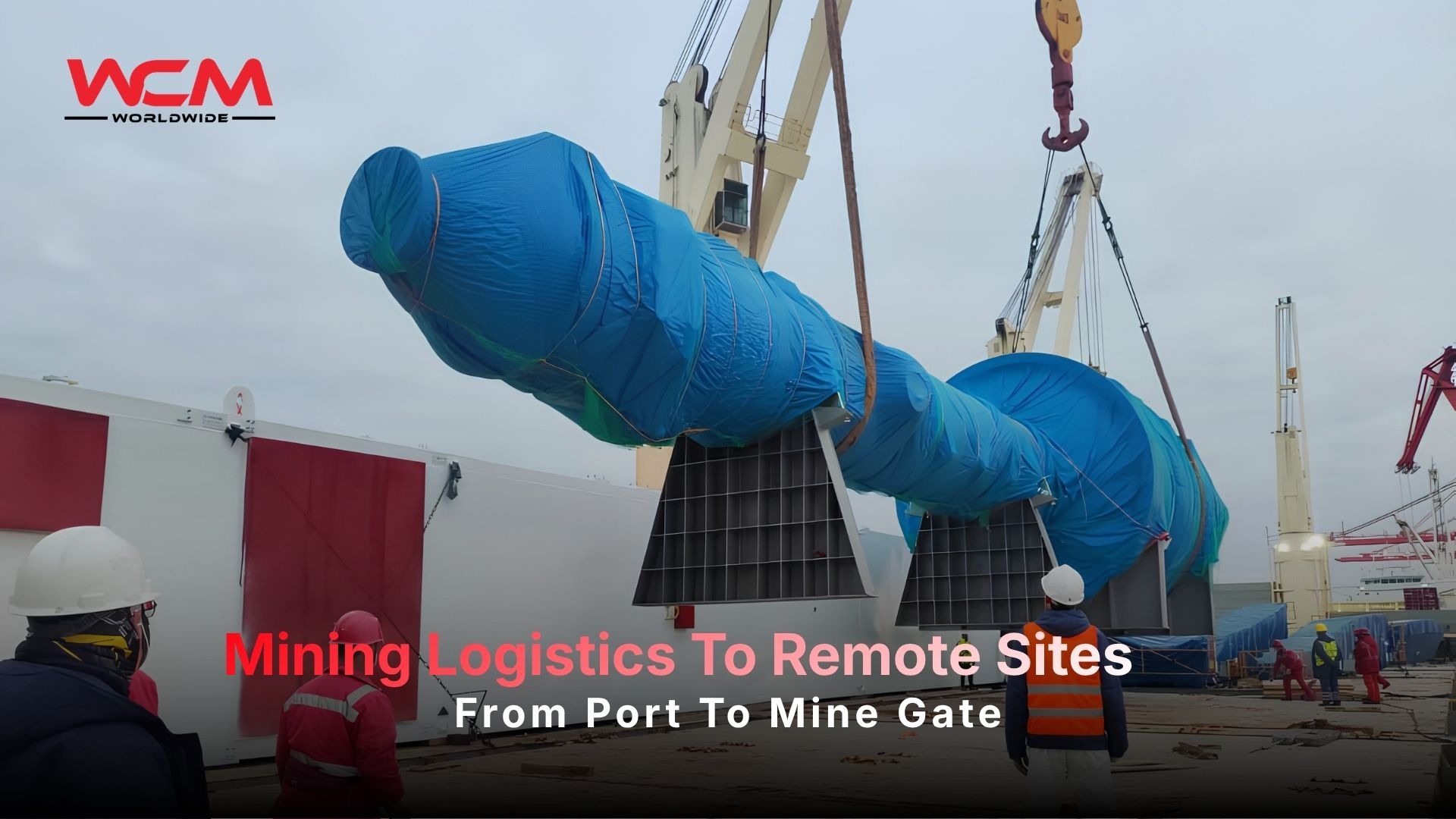
Capital equipment moves are project cargo by any reasonable definition. A SAG mill shell is typically eight to twelve meters in diameter, weighs several hundred metric tons in a single piece, and ships with a tightly defined arrival window because every other plant construction milestone depends on it.
Planning for these moves runs on three rules.
Cargo engineering precedes everything
Confirmed dimensions, weight, center of gravity, and lashing point load capacities determine every downstream decision. Vessel selection, port crane capacity, route survey, transport mode, escort count, and axle loading all depend on the engineering data. Incomplete data at the front end compounds into a routing failure at the back end.
Heavy lift capacity is booked early
The 2026 heavy lift market is structurally tight as offshore wind, oil and gas, and mining demand converge on the same fleet. Capital equipment moves now routinely require the 180-day end of the standard heavy lift charter planning range rather than the 90-day end. On the most constrained corridors such as West Africa and the high Andes, booking pressure starts earlier still.
The last mile is engineered, not improvised
Route surveys for inland transport of mining capital equipment cover bridge clearance, road surface and camber, turning radius at switchbacks, axle load limits, escort permitting, and overnight stopping points where the load can be safely parked. On some corridors the survey identifies bridges that have to be reinforced or bypassed before the cargo arrives. This is engineering work running on the freight timeline, not paperwork to handle in transit.
Mill Consumables: The Grinding Media Program
Mill consumables are the highest-volume, most operationally consequential, and least visible category of mining freight. A large copper concentrator with a SAG mill and three ball mills consumes forged steel grinding media at a rate measured in hundreds of tons per month. Across the global mining industry, grinding media ranks among the largest single categories of consumable industrial freight by volume.
Grinding media programs have three characteristics that distinguish them from general bulk freight.
Steady, predictable cadence
A mill in steady-state operation has a known consumption rate per ton of ore processed. The program is built around that consumption rate, with safety stock measured in days of consumption rather than absolute tonnage. The freight schedule has to be hit on its published cadence.
Single-source supply
Grinding media for major operations comes from a small group of qualified manufacturers, with each mill running specific ball diameters, hardness profiles, and chemistries qualified for its ore. Switching suppliers mid-program is technically possible but operationally expensive. The logistics program is built around the qualified supplier.
Lost production cost dominates
If the next vessel of grinding media misses its arrival window and the mill draws down safety stock to zero, throughput drops or the mill stops. The downstream cost is on a different order of magnitude than the freight bill. Grinding media logistics is therefore designed for reliability first, and freight cost is optimized second.
WCM manages grinding media and mill consumables programs as part of its mining service, with active client work that includes ME Elecmetal among others.
Spare Parts: When Air Freight Is the Cheap Option
Spare parts logistics for mining looks like air freight on a flowchart and crisis management in practice. A failed primary mill drive, a seized hydraulic cylinder on a shovel, a fractured bearing on a conveyor head pulley each represents a piece of equipment that is now down, with a replacement part that is days to weeks away by ocean and possibly hours away by air.
The math is the inverse of the math behind grinding media planning. Freight cost is small relative to the part value, and the part value is small relative to the lost production cost. A bearing that costs forty thousand dollars air-freighted from Europe instead of two thousand dollars by ocean is a thirty-eight thousand dollar freight premium that buys two weeks of mill operation. That is typically tens of millions of dollars of revenue.
Critical spares classification
Operating mines maintain classified spare parts lists ranking each part by criticality. The classification determines what is held on site, what is held at a regional warehouse, and what is sourced on demand. The logistics program follows that classification rather than building a separate one.
Origin-side stockholding
Several mining OEMs operate consignment stock or regional spare parts warehouses positioned for mining customers in Antofagasta, Lima, Johannesburg, Dubai, Perth, and Brisbane. The fastest spare parts moves are between consignment stock and mine gate, not between OEM factory and mine gate. Planning starts with identifying where the part actually is.
Last-mile resilience
Air freight delivers a spare part to an airport. The airport is often hours from the mine. Light-vehicle expedite, helicopter charter for sites in the high Andes or remote West Africa, and 24-hour customs and gate-clearance protocols are part of what spare parts air freight actually means in mining practice.
The Inland Transport Reality
The ocean leg lands cargo at a port. The inland leg decides whether the cargo arrives on schedule. Four characteristics make the inland leg the operational bottleneck on most mining programs.
Port capability matters more than port distance
A mine that is 800 kilometers from a port with heavy-lift cranes, paved access road, and rail connection is logistically closer than a mine 300 kilometers from a port that lacks any of those. Port selection is one of the highest-leverage decisions in a mining logistics program.
Roads degrade in predictable patterns
Wet-season degradation in tropical mining corridors such as the Democratic Republic of the Congo, Ghana, and Indonesia, snow and ice closures in the high-altitude Andean and Central Asian corridors, and dust-induced surface failure across Australian and Saharan operations all impose seasonal windows. The freight program either respects the window or pays the wet-season premium.
Border crossings and landlocked routings
Mines in landlocked countries such as Zambia, the Democratic Republic of the Congo, Mongolia, Kazakhstan, and Bolivia move cargo across at least one and often several borders. Each border adds documentation, permits, escort requirements, and the risk of stoppage. Cross-border logistics expertise is mining logistics on any landlocked corridor, not a separate service.
Permits, escorts, and lead times
Oversize and overweight permits, police or military escort vehicles, route surveys, and bridge approvals all carry their own lead times, often measured in weeks rather than days. These are calendar items in the freight plan, not paperwork to handle at the dock.
Why Mining Logistics Matters More in 2026
Mining logistics has historically been a niche industrial discipline. It has become a strategic one in the current decade for three connected reasons.
Critical minerals are now treated as strategic supply by US and European trade policy. Lithium, copper, cobalt, nickel, and rare earth elements have become priorities for grid storage, electric vehicle production, and semiconductor manufacturing. Operating mines reaching their production targets on schedule is now a policy concern as well as a commercial one.
New mining investment is concentrated in remote, infrastructure-constrained corridors. Lithium in the Andean salt flats, copper in central Africa and Mongolia, rare earths in Australia and Greenland, and nickel in Indonesia and the Philippines all sit in the parts of the world where mining logistics is hardest. The combination is structural rather than cyclical.
Heavy lift capacity is tight. Offshore wind, oil and gas, and mining all draw on the same specialized fleet, and the booking horizon for capital equipment moves has lengthened accordingly. Mining operators that historically relied on opportunistic freight sourcing are restructuring around contracted, integrated programs because the cost of being wrong has gone up.
Why Mining Logistics Shipments Fail
Most mining logistics problems are preventable. The common failures include:
- Incomplete cargo engineering data at planning, leading to vessel and route mismatches discovered too late to fix
- Single-vendor freight sourcing with no fallback if the carrier or charter slips
- Treating mill consumables as a series of one-off bookings rather than a steady program with safety stock
- Underestimating the inland leg in both cost and schedule, particularly on landlocked routes
- Booking heavy lift capacity inside 90 days on the most constrained corridors
- Missing seasonal road windows because the freight plan was built around ocean ETAs rather than mine-gate delivery
- Ordering spare parts through general freight channels when criticality demands air freight and last-mile expedite
- Handling customs clearance in transit rather than pre-planning for the destination country's documentation requirements
These failures rarely appear as a single dramatic event. They compound. A capital equipment move that arrives two weeks late combines with a grinding media schedule that drifts and a spare parts order routed through ocean freight, and the mine quietly loses operating hours that show up in the quarterly throughput numbers rather than on any freight invoice.
How WCM Worldwide Handles Mining Logistics
WCM treats mining as a published service line rather than a general-cargo capability, designed around mine availability rather than freight rate.
- Capital equipment planning for SAG mills, ball mills, crushers, conveyor systems, and processing modules across heavy lift, out of gauge, and full or part charter operations
- Grinding media and mill consumables replenishment programs designed around the mill's consumption rate, with service contracts on the ocean leg and safety stock buffering at port or regional warehouse
- Critical spare parts air freight with last-mile expedite, helicopter charter where required, and 24-hour customs and gate-clearance protocols
- Inland transport coordination across the Andean copper and gold belt, West Africa, Central Asia, and Australia, including landlocked border crossings, route surveys, and escort permitting
- FMC-licensed NVOCC ocean freight with service contracts across all major carriers, verifiable on the FMC public Ocean Transportation Intermediary database
- US and origin-country customs brokerage integrated with the freight workflow rather than handled by a separate vendor
- A global network of 496 offices in 97 countries, including offices closer to many mining destinations than to the nearest major port
The value of this structure is that ocean freight, customs, inland transport, and last-mile delivery sit inside one accountable team rather than across separate vendors. WCM's leadership team carries 100+ years of combined experience built at FedEx Logistics, CEVA, COSCO, CMA CGM, and Kuehne+Nagel, with direct project cargo experience moving firefighting helicopters and other oversized equipment across the Pacific. Mining logistics behaves better when the people running it have already seen what fails on the high-altitude routes, in the wet season, and at landlocked border crossings.
Final Considerations for Mining Operators and EPCMs
Mining logistics matters most when the mine is large, the destination is remote, and the operation is continuous. The freight program either supports availability or quietly erodes it, and the difference rarely shows up on the freight invoice.
A practical checklist for evaluating a mining freight program:
- Does the program cover all three cargo categories (capital equipment, mill consumables, spare parts) under one operator?
- Is the grinding media schedule designed around the mill's consumption rate and safety stock, or quoted per shipment?
- Is heavy lift capacity contracted on a planning horizon that matches the project schedule?
- Is the inland leg engineered with route surveys, escort permits, and seasonal windows, or improvised at the port?
- Is customs cleared in advance, or handled when the cargo arrives?
If you operate or are commissioning a mine that depends on imported capital equipment, recurring mill consumables, or expedited spare parts, WCM can review your current freight program against the three-category framework above. The conversation typically starts with current cadence, current ports, and the mine's operational uptime target. Reach out through the WCM mining team with cargo specifications and the trade lanes you operate.
Request a Quote | Call: (800) 209-5601 | Email: info@wcmchs.com
Frequently Asked Questions
What is mining logistics?
Mining logistics is the discipline of moving capital equipment, mill consumables, and spare parts from origin manufacturers to mining sites. Those sites are typically remote, often landlocked, and operating continuously. The work integrates ocean freight, port handling, inland transport across difficult terrain, customs clearance, and last-mile delivery to the mine gate. It is judged by mine availability rather than freight cost per ton.
What are the three main categories of mining cargo?
Mining cargo divides into capital equipment, mill consumables, and spare parts. Capital equipment covers one-time project moves of mill components, crushers, conveyors, and processing modules on 90 to 180 day planning horizons. Mill consumables cover recurring replenishment programs for grinding media, mill liners, reagents, and lubricants on weekly to monthly cycles. Spare parts cover urgent ad hoc moves of bearings, hydraulic components, and control parts, usually by air freight with last-mile expedite. Each category demands a different routing, mode, and contracting structure.
How is grinding media shipped to a mine?
Grinding media is shipped as a recurring program rather than as individual bookings. A large concentrator consumes hundreds of tons per month, supplied by a small group of specialized manufacturers including ME Elecmetal. The freight program is built around the mill's consumption rate, with service contracts on the ocean leg, safety stock buffer at port or regional warehouse, and integrated inland delivery to the mine gate. Reliability is engineered for first, and freight cost is optimized second.
Why is air freight often the right choice for mining spare parts?
Mining spare parts are typically high-value, low-weight components whose absence stops a much larger piece of equipment. The cost of a stopped grinding mill or shovel measured in lost production is normally far higher than the freight premium for moving a critical bearing or hydraulic component by air rather than ocean. In mining spare parts logistics, air freight is usually the lower-total-cost option even though the freight invoice itself is higher.
What makes inland transport the hardest part of mining logistics?
The ocean leg lands cargo at a port. The inland leg has to handle remote and often landlocked destinations, seasonal road degradation, oversize and overweight permits, escort vehicle requirements, route surveys for bridge clearance and axle loading, and border crossings on landlocked routes. Most schedule failures originate in the inland leg, not the ocean leg, and the ocean rate is usually a small share of total landed cost.
Which mining corridors does WCM operate in?
WCM moves mining cargo across the Andean copper and gold belt (Chile, Peru, Argentina), West Africa (Ghana, Mali, Burkina Faso, the Democratic Republic of the Congo), Central Asia (Kazakhstan, Mongolia), and Australia. The service combines breakbulk and project cargo execution for capital equipment, recurring program management for mill consumables, and expedited air freight protocols for spare parts. Named client work includes ME Elecmetal, the grinding media manufacturer.