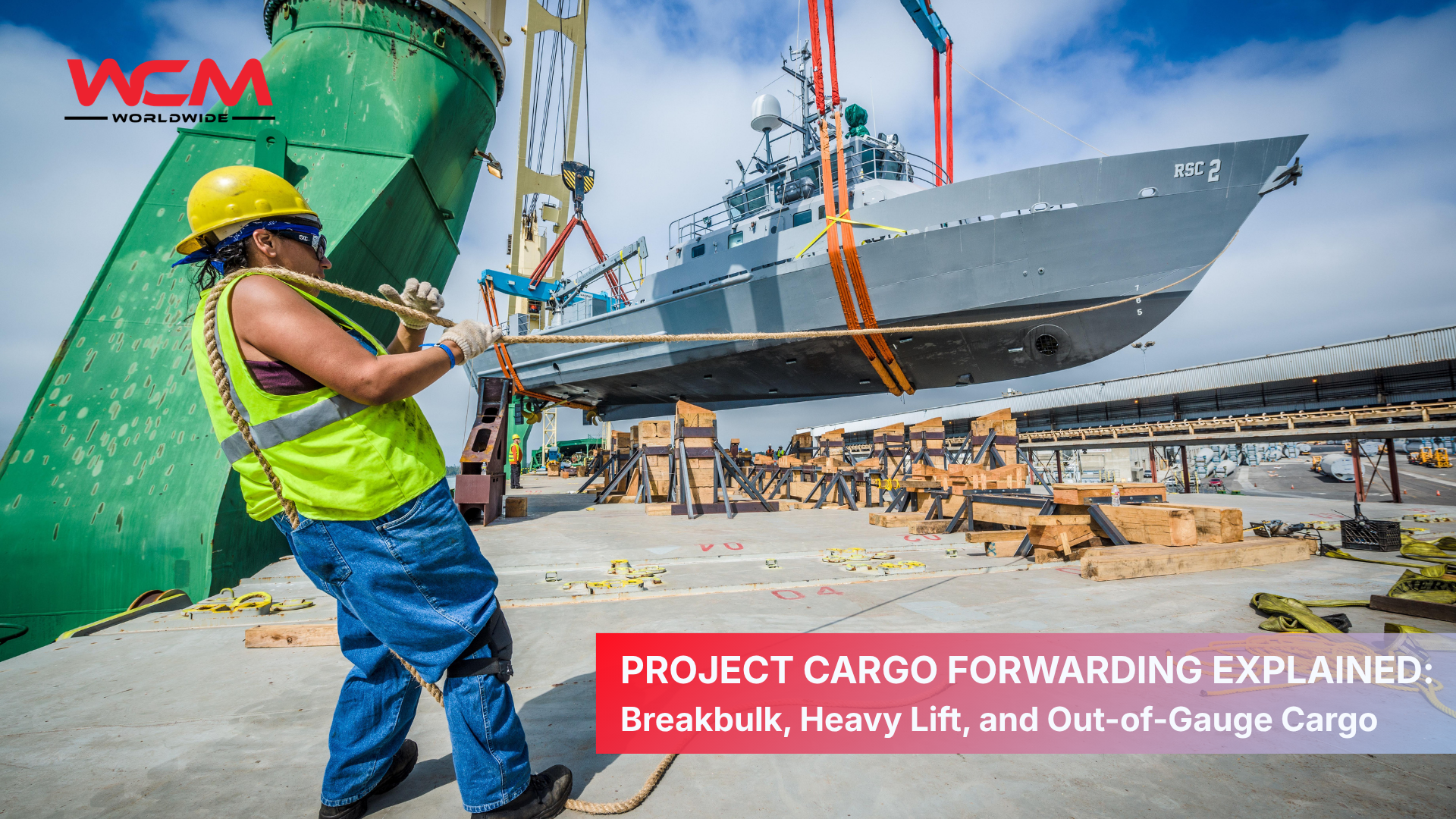
Project cargo forwarding is the specialized freight forwarding discipline for cargo that moves on scheduled liner container services, MPP or RoRo Carrier services. The cargo falls into three categories: breakbulk, heavy lift, and out-of-gauge. The forwarder coordinates the end-to-end movement, from origin engineering to destination installation, across vessels, ports, customs, and inland transport that were not designed for the cargo.
Before engaging a project cargo forwarder, a few practical factors decide whether the engagement is necessary in the first place:
- Whether the cargo falls into breakbulk, heavy lift, or out-of-gauge categories
- Cargo dimensions and weight relative to standard container limits
- Whether a charter vessel is required or implied
- Project timeline tied to a fixed installation or commercial operation date
- Number of vendors, ports, and modes involved in a single move
- Destination accessibility and inland transport complexity
- Customs and regulatory exposure across multiple jurisdictions
- The cost of schedule failure compared to the freight cost
Industrial and energy projects do not run on freight invoices. They run on critical-path schedules. When the transformer arrives in week 42 instead of week 39, the construction program slips, commissioning slides, and the commercial operation date moves with it. The cargo that defines this category cannot be re-quoted on a different liner sailing.
Project cargo forwarding exists because breakbulk, heavy lift, and out-of-gauge moves require an integrated discipline of engineering, contracting, and execution that a standard containerized freight forwarder does not handle as a routine matter. The partner is closer to a construction logistics coordinator than a generalist booking agent, and the work begins long before the cargo is ready to ship.
WCM Worldwide operates project cargo forwarding as a dedicated service across its breakbulk and project cargo and special projects practice.
What Project Cargo Forwarding Actually Means
Project cargo forwarding is the specialized freight forwarding discipline for cargo that does not fit standard liner container services. The forwarder coordinates the end-to-end movement of breakbulk, heavy lift, and out-of-gauge cargo from origin manufacturer to destination installation site, handling vessel selection, charter contracting, port operations, customs work, and inland transport as an integrated program.
The work overlaps with general freight forwarding in some areas. Booking, documentation, and customs coordination apply to all freight, project or otherwise. But a project cargo forwarder also handles cargo engineering, charter party negotiation, port and crane capacity matching, route surveys for inland transport, and on-site delivery support up to the installation lift. Most of that work begins long before the cargo is ready to ship.
Capital equipment for refineries, mining mills, wind farms, transformer substations, modular construction units, and pre-assembled industrial plant all move through project cargo forwarders. The freight is the visible part. The engineering, contracting, and coordination behind it are what determine whether the cargo arrives on schedule.
The Three Categories of Project Cargo
Project cargo is not a single cargo type. It is an umbrella term covering three distinct categories that share one characteristic: each one falls outside what scheduled liner container services can carry. A project cargo forwarder works across all three, with different equipment, vessels, and engineering for each.
Breakbulk Cargo
Breakbulk cargo is general cargo loaded piece by piece rather than packed inside ocean containers. The cargo is typically large, heavy, or irregular in shape, and is handled with cranes and lifting gear at both load and discharge ports. Steel beams, pipes, machinery parts, and wind turbine components are common breakbulk profiles. These items usually move on multipurpose vessels or general cargo vessels with in-hold and on-deck stowage planned around the cargo profile.
Heavy Lift Cargo
Heavy lift cargo covers extremely heavy items, often weighing over 100 metric tons in a single piece. The move requires specialized equipment including heavy-lift cranes, self-propelled modular transporters (SPMTs), and engineered lashing arrangements. Transformers, generators, industrial reactors, and oil and gas modules are typical heavy lift cargo. These moves usually require a heavy lift vessel or semi-submersible heavy transport, with BIMCO HEAVYCON 2007 or HEAVYLIFTVOY charter parties governing the contract.
Out-of-Gauge (OOG) Cargo
Out-of-gauge cargo exceeds standard container dimensions in height, width, or length, and cannot fit inside regular containers without modification. The cargo moves on flat racks, open-top containers, or as breakbulk on multipurpose vessels, depending on how much it exceeds the standard envelope. Large vehicles, construction equipment, long pipes, and wind turbine blades are typical OOG profiles. The move requires route surveys at both ends, because the cargo will exceed road and rail clearance limits on inland transport as well.
| Cargo Type | Key Feature | Common Examples |
|---|---|---|
| Breakbulk | Non-containerized general cargo loaded piece by piece | Steel beams, pipes, machinery parts, wind turbine components |
| Heavy Lift | Single pieces above 100 metric tons | Transformers, generators, industrial reactors, oil and gas modules |
| Out-of-Gauge (OOG) | Oversized beyond standard container limits | Large vehicles, construction equipment, long pipes, wind turbine blades |
A single project move often involves cargo from more than one of these categories. A refinery construction package can include heavy lift transformers, breakbulk piping, and OOG modular skids on the same shipment. The forwarder coordinates the engineering, vessel selection, and execution across all of them.
The Four Operational Disciplines of a Project Cargo Forwarder
A project cargo forwarder brings four distinct disciplines together under one accountable team. Each is its own area of work, and a serious project move requires all four. Splitting them across separate vendors is one of the most common ways a project cargo program fails.
Cargo engineering
Confirmed dimensions, weight, center of gravity, and lashing point load capacities determine every downstream decision. Cradle and saddle design, environmental sensitivity, hazardous classification, and insurance underwriting all start from the engineering data sheet. Without it, the move is a guess.
Vessel and route planning
Vessel class selection covering multipurpose, heavy lift, semi-submersible, and deck carrier classes, with charter form selection across HEAVYCON, HEAVYLIFTVOY, and GENCON. Trade lane analysis, port pairing, draft restrictions, and air draft constraints at intended ports all feed the routing decision. The route is engineered for the cargo, not for the next available sailing.
Port and inland coordination
Berth allocation, crane and stevedoring capacity, route surveys for bridge clearance and axle loading, escort permitting, customs at both ends, and last-mile delivery on roads that were not designed for the cargo. Most schedule failures originate in this leg, not at sea.
On-site delivery and installation support
SPMT operations, jacking and skidding, on-site rigging coordination, and marine warranty surveyor engagement at the lift point. The freight job is not done at the port. It is done when the cargo is in position for installation.
When You Need a Project Cargo Forwarder
Not every move needs a project cargo forwarder. Most cargo moves on liner container services, where a standard freight forwarder or NVOCC is the right partner. The partner type changes when the cargo, the schedule, or both fall outside what a liner container program can handle.
| Cargo or Project Type | Right Partner |
|---|---|
| Standard FCL or LCL containerized freight | Standard freight forwarder or NVOCC |
| Breakbulk, heavy lift, or OOG industrial cargo | Project cargo forwarder |
| Multi-vendor inbound at scale | Freight forwarder with PO management capability |
| Mining capital equipment to remote sites | Project cargo forwarder |
| Time-critical EPC delivery windows | Project cargo forwarder |
| Sustained high-volume FCL exports | NVOCC with service contracts |
The decision is not whether the project needs ocean freight. Every project does. The decision is whether the cargo falls into one of the three project cargo categories above, and whether the project schedule depends on the engineered execution that a project cargo forwarder provides.
How to Evaluate a Project Cargo Forwarder
Three criteria separate a real project cargo forwarder from a generalist freight forwarder using the project cargo label as a marketing line.
Licensing and credentials
An FMC NVOCC license confirms the company can act as a principal under its own House Bill of Lading rather than as a pure forwarding agent. The FMC publishes its Ocean Transportation Intermediary list publicly, and any project owner can verify the licensing status of a claimed NVOCC. A separate CBP customs broker license confirms the company can handle US import and export filings inside the same workflow as the freight.
Charter and carrier access
A project cargo forwarder should be able to demonstrate active charter capability, including past moves on the relevant BIMCO charter forms (HEAVYCON, HEAVYLIFTVOY, GENCON) and a credible relationship with vessel owners in the heavy lift and multipurpose segments. Direct service contracts with major liner carriers for the supporting containerized legs matter as well.
Network and references
A real project cargo forwarder has offices or qualified agents on the corridors where the move will execute, not only in the head office country. References should include similar cargo profiles, similar routes, and similar project complexity. A forwarder that has moved a mill shell to a Chilean mine site is genuinely useful for a similar Andean move. A forwarder that has only moved containers is not.
Why More Projects Need a Project Cargo Forwarder in 2026
Three trends are pulling more industrial and energy projects toward dedicated project cargo forwarders.
Heavy lift capacity is structurally tight. Offshore wind installation, oil and gas decommissioning, and mining capital equipment are all drawing on the same specialized vessel fleet, and booking horizons have lengthened accordingly. Securing charter capacity now requires sustained relationships with vessel owners, not opportunistic sourcing.
Project complexity is rising. Modular construction strategies, pre-assembled units, and large single-piece equipment shipments are increasingly common. The result is more cargo that does not fit liner services and more projects with critical-path freight dependencies.
EPCMs are outsourcing freight execution. The discipline of project cargo forwarding has separated from the EPCM contract over the last decade, and project owners are increasingly engaging dedicated project cargo forwarders rather than relying on the EPC contractor to also manage freight. The trend is toward specialization, not consolidation.
Why Project Cargo Forwarding Engagements Fail
Most project cargo forwarding problems are preventable. The common failures include:
- Engaging the project cargo forwarder too late in the project schedule to influence cargo packaging, port selection, or charter timing
- Treating the engagement as a freight quote rather than an engineering and contracting discipline
- Splitting cargo engineering and freight execution across separate vendors with no clear handoff
- Underestimating charter market lead times and missing the booking window on capacity-constrained corridors
- Allowing the EPC contractor to subcontract freight execution to a generalist forwarder rather than a project cargo specialist
- Failing to align customs preparation at both origin and destination with the cargo arrival schedule
- Overlooking inland infrastructure constraints (bridges, roads, escort permits) until cargo is already at the port
- Skipping marine warranty surveyor engagement on cargo that the insurance underwriter requires it for
These failures rarely appear as a single dramatic event. They compound. A late engagement combines with a missed charter window, an underprepared port, and an inland leg that was never engineered, and the project slips by weeks before any single issue is named as the cause.
How WCM Worldwide Handles Project Cargo Forwarding
WCM treats project cargo forwarding as a published service line built around engineered moves across all three project cargo categories: breakbulk, heavy lift, and out-of-gauge.
- Cargo engineering for breakbulk, heavy lift, and OOG profiles covering dimensions, weight, center of gravity, lashing capacity, cradle requirements, and environmental sensitivities at the planning stage
- Vessel selection and charter contracting across heavy lift, multipurpose, semi-submersible, and deck carrier classes, with BIMCO charter form negotiation (HEAVYCON, HEAVYLIFTVOY, GENCON)
- Port and terminal coordination for berth, crane, stevedoring, and escort permits at load and discharge ends
- Inland transport engineering including route surveys, axle loading analysis, bridge clearance verification, and cross-border coordination on landlocked corridors
- FMC-licensed NVOCC ocean freight with service contracts across all major carriers, verifiable on the FMC public Ocean Transportation Intermediary database
- US customs brokerage and origin-country customs work integrated with the freight workflow rather than handled by a separate vendor
- On-site delivery support including SPMT operations, jacking and skidding coordination, and marine warranty surveyor engagement
- A global network of 496 offices in 97 countries that puts an office near most project destinations rather than only near the head office
The value of this structure is that cargo engineering, charter contracting, port coordination, customs, and inland execution sit inside one accountable team rather than across separate vendors. WCM's leadership team carries 100+ years of combined experience built at FedEx Logistics, CEVA, COSCO, CMA CGM, and Kuehne+Nagel, including direct project cargo experience moving firefighting helicopters and other oversized equipment across the Pacific. Project cargo forwarding behaves better when the people running it have already seen what fails on the heavy lift corridors, in the wet season, and at landlocked border crossings.
Final Considerations for Project Owners and EPCMs
Project cargo forwarding matters most when the project depends on breakbulk, heavy lift, or out-of-gauge cargo with critical-path schedule dependencies. The engagement either supports the schedule or quietly absorbs slack that the project did not have.
A practical checklist for evaluating whether your project needs a project cargo forwarder:
- Does the cargo fall into the breakbulk, heavy lift, or out-of-gauge category?
- Is any single cargo piece outside the standard container envelope?
- Does the move require charter vessel capacity rather than liner space?
- Is the cargo arrival date tied to a fixed construction or commercial operation milestone?
- Is the destination remote, landlocked, or infrastructure-constrained?
If you operate or are commissioning a project that involves breakbulk, heavy lift, or out-of-gauge cargo, the WCM project cargo team can review your scope against the four operational disciplines above. The conversation typically starts with cargo specifications, the destination corridor, and the project schedule. Reach out through the WCM project cargo team to discuss the right structure for your move.
Frequently Asked Questions
What is a project cargo forwarder?
A project cargo forwarder is a specialized freight forwarder that handles end-to-end movement of breakbulk, heavy lift, and out-of-gauge cargo. The discipline combines cargo engineering, vessel and route planning, port and inland coordination, customs work, and on-site delivery support under one accountable team. Project cargo forwarding is distinct from standard containerized freight forwarding because the cargo does not move on liner container services and the work begins long before the cargo is ready to ship.
What are the three main categories of project cargo?
Project cargo divides into breakbulk, heavy lift, and out-of-gauge. Breakbulk cargo is loaded piece by piece rather than in containers and includes steel beams, pipes, machinery parts, and wind turbine components. Heavy lift cargo covers single pieces above roughly 100 metric tons such as transformers, generators, and industrial reactors. Out-of-gauge cargo exceeds standard container dimensions and includes large vehicles, construction equipment, long pipes, and wind turbine blades. Many real projects involve cargo from more than one category in a single shipment.
How is project cargo forwarding different from general freight forwarding?
General freight forwarding focuses on booking, documentation, and customs coordination for cargo that moves on scheduled liner container services. Project cargo forwarding handles cargo that cannot move on liner services and adds cargo engineering, charter party negotiation, port and crane capacity matching, route surveys, and on-site delivery support to the standard forwarding scope. The work begins at the cargo engineering stage rather than at the booking stage, often months in advance of the shipment date.
When does a project actually need a project cargo forwarder?
A project needs a project cargo forwarder when the cargo falls into the breakbulk, heavy lift, or out-of-gauge category, when the project schedule depends on fixed delivery windows that liner services cannot guarantee, when charter vessel capacity is required, or when the move involves multiple ports, modes, and vendors that need coordinated arrival sequencing. When two or more of these conditions apply, project cargo forwarding is the right service category rather than standard containerized freight forwarding.
What credentials should a project cargo forwarder hold?
A serious project cargo forwarder should hold an FMC NVOCC license, which can be verified on the FMC public Ocean Transportation Intermediary database. A CBP customs broker license is valuable when the move involves US imports or exports, since it allows ISF filing and entry preparation to run inside the same workflow as the freight. References on similar cargo profiles and similar trade corridors are the third credential that matters, since project cargo experience does not transfer cleanly across cargo types.
How far in advance should I engage a project cargo forwarder?
For heavy lift and charter-based moves, engagement should begin 90 to 180 days before the cargo is ready to ship, and in capacity-constrained markets the longer end of that range is closer to typical. Engagement that starts at the freight booking stage rather than at the cargo engineering stage usually misses the most useful contributions a project cargo forwarder can make, including charter form selection, port pairing, and inland route engineering.